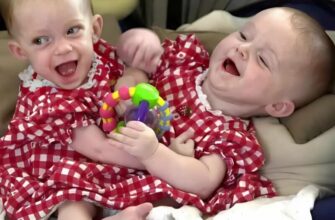
These brothers from Brazil were born with their heads fused together and had to share not only important blood vessels, but also half their brains. 😢 When the boys were 4 years old, doctors decided to separate them. 😲
The operation lasted 23 hours and involved nearly 100 specialists. 😨 Fortunately, the separation was successful, but today the brothers have developmental problems and are learning to speak and walk again. 😱 Images of these exceptional conjoined twins after the operation were shown in the first comment. 👇 👇
In August 2022, in Brazil, what doctors did not hesitate to call a medical miracle occurred. Two boys, Arthur and Bernardo Lima, born in 2018, had always been inseparable—in the literal sense of the word.
They were born with an extremely rare anomaly: their skulls were fused at the top. These children are called craniopagus and occur approximately once every two and a half million births.

From birth, the brothers had to share not only blood vessels and part of their brain, but also every moment of their lives.
For almost four years, they slept, ate, and played side by side, without even being able to see each other completely. Imagine: you hear your brother’s voice, you feel his breath, but you can’t look him in the eye.
The boys’ parents sought help from the Institute of Child Health in Rio de Janeiro, where more than 100 specialists treated their case.
Under the direction of the excellent surgeon Noor Suryate Gurjar, known for his successes with conjoined twins in India, a long preparation began.

What made this story particularly remarkable was the use of cutting-edge technology. For the first time in Brazil, doctors created detailed 3D models of Arthur and Bernardo’s skulls and performed rehearsals of the operation in virtual reality, using VR headsets, to practice the separation of blood vessels and brain structures in minute detail.
This allowed them to simulate the most critical moments—because one false move could have cost both children their lives.
For several months, the children underwent eight preparatory procedures. Then came the big day. The final operation lasted more than 23 hours.
The doctors worked as a team, without leaving the operating room, determined to give the two brothers a chance at a normal life.

And when the separation was finally complete, everyone held their breath. Arthur and Bernardo lay side by side—but this time separate.
The doctors gently turned their heads toward each other. For the first time in four years, the brothers looked into each other’s eyes. Witnesses described how the operating room erupted in applause and tears of joy.
Today, the boys are undergoing extensive rehabilitation. They must learn to stand, sit, and move independently, as their bodies were previously fully coordinated.